

Drifting into the wild: A slow journey along India’s Brahmaputra
He lay there in the warm sand like a holidaymaker at the seaside, relaxed and stretched out in the shade of a palm tree. Assam’s midday heat had made him drowsy, and he had probably dozed off, dreaming of gazelles, when we woke him. Now, as our ship drifted past, he sat up and looked over.
Like all cats, tigers can hold a gaze endlessly. They fix on their target and seem to look deep into the soul, into its very furthest corners. This tiger sat motionless in the Brahmaputra’s riverbank sand, his head following the ship. Then, before any of us could even reach for a camera, he disappeared behind the next sandbar. It took us a while to find words for what we had seen, as if we were slowly waking from a dream into reality.

In a weird way, the word “slowly” fits a river cruise in India well. Normally, the country overwhelms a traveller on arrival, a frontal assault on the senses as well as certainties. Look here! Look there! Stop! Marvel at my colours! Listen to me! The first hours can get to be too much – too much splendour, too many smells, too many sounds, too many types of bread on the menus.
But on a ship, you approach things slowly. Minute by minute. River kilometre by river kilometre. Anyone exploring India via a river like the Brahmaputra needs to do nothing more at first than let the nation drift past.
In the mornings, Assam made it even easier for passengers. One never saw much then – the fog lay too dense over the river, the fields beyond the sandbanks too flat, the mighty peaks of the Himalayas too far away.
On deck, a cup of tea in hand, it felt as if one were walking straight into the clouds. Then the crimson sun would rise behind the mist, looking like a strange planet in another universe. Outlines of the landscape would emerge from shadow, then dissolve again.
Eventually, silhouettes of palms on the riverbanks would cut their way out of the haze. This could take an hour, sometimes two, until the entire world of the Brahmaputra was revealed. Those who wanted to sleep in perhaps thought they would miss very little. And yet, each morning, they missed the creation of the world as it emerged from the veil of mist.
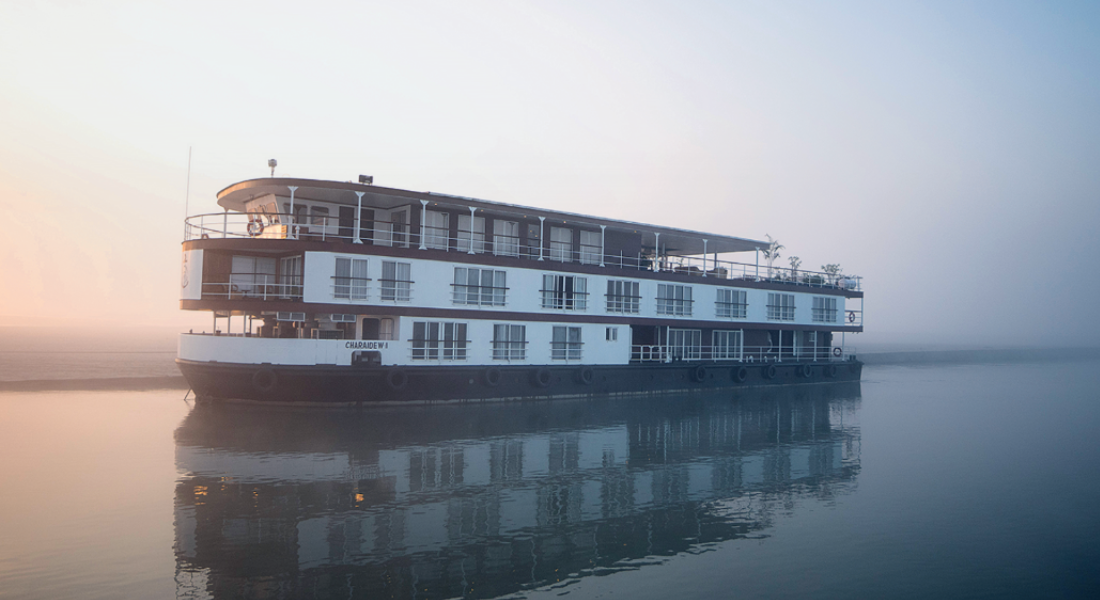
River cruises on the Brahmaputra, which can stretch up to ten kilometres wide, have only been possible for a few years. The Charaidew II is 44 metres long, with 18 cabins and space for a maximum of 36 passengers. It has a lounge with sofas and armchairs, a restaurant, and a large deck with seating areas and sun loungers.
“Old-world elegance of the Assam tea planters’ lifestyle,” the ship’s brochure calls it. During the day, two or three stops are on the programme, usually at temples and for lunch on old tea plantations. Before and after, passengers can watch from the deck as a part of India passes by a tourism seems yet to be discovered.
The simple village huts on the sandy banks are built of bamboo; sometimes, one sees children playing or women carrying huge bundles of laundry. Sometimes, one may even see a tiger.
The Brahmaputra is capricious. In autumn and winter, it meanders along lazily, and Captain Bimal Mondal on the Charaidew II has no trouble finding a passage between the many islands and sandbanks. By late June, however, when the skies over India open with the monsoon, the volume of water increases fivefold.
Then the Brahmaputra fans out into more than a hundred channels, the sandbanks and islands vanish, and no one can say whether they will reappear after the flood.
Take Majuli Island, for example. With endless rice fields and spanning over 400 square kilometres, it is one of the world’s largest river islands – but, just a few years ago, it was a third larger.
Though built on sand, some places have lasted forever, like the Uttar Kamalabari monastery. Founded at the end of the 16th century at the centre of the island, it’s known for its drumming monks – nine of whom have gathered in a hall today.
They wear white robes and have large drums slung around their necks – it’s not entirely clear whether their dance is part of a daily ritual or a rehearsal for a later performance. Their drumming intensifies, their steps grow quicker and quicker, until the watching and listening start to feel hypnotic.
Back on the ship, it is as if someone has turned the volume of the world down. Even during the day, the river is quiet, but when darkness descends upon Assam like a heavy cloth, it becomes utterly still.
One hears only the gentle gurgling of the river and the sound of sand breaking off from the banks and sliding into the water. Even the crew, so cheerful during the day, converse only in whispers, as if not to disturb the silence. On such evenings, when the world seems to hold its breath, Captain Mondal has chairs carried onto the nearest sandbank and a large fire lit.
Later, his passengers sit in a semicircle, heads tilted back, gazing at the stars, the images of the day still vivid. By ten o’clock, everyone is in bed.
The next morning, the Brahmaputra is so smooth that the Charaidew II seems to glide on liquid glass. The river widens, and soon the nearby shore is nothing more than a distant vision, a fine line between pale blue sky and glittering water.
Now and then, fishermen appear at the painted horizons in narrow boats carved from tree trunks – the same kind used here for two millennia or more. Sometimes a sisu breaks the surface. Few of these river dolphins remain – experts estimate perhaps 200. They leap from the water and vanish so quickly that one is left unsure whether one really saw them at all.
Only the drive from the pier into Kaziranga National Park brings us back to Indian reality – half an hour in the traffic is enough. Assam’s largest national park lies on the southern bank of the Brahmaputra and is especially famous for its one-horned rhinos.
The two-and-a-half-tonne colossi can easily be observed from the main road – NH (National Highway) 37 is probably the only highway in the world with signs for ‘Rhino Viewing Platforms’. You can simply pull over and have a clear view of one of the rarest mammals on earth, some 2,500 of which live in the park.
Since there is no fence between Kaziranga and the rest of Assam, rhinos are often found on or near the road. Hundreds of warning signs alert drivers, and some corridors even have a traffic light warning system – whenever rhinos (or elephants, or buffalo, or deer) approach, a park official switches on the lights and all traffic comes to a halt.
Kaziranga safaris are as relaxed as rides on the Brahmaputra. Open jeeps roll through dense forests, where trees scatter sunlight into delicate beams. Then the jungle opens up. Much of the park is grassland – to observe animals, one needs only to stop, and there they are, right in front of you. You look out over the plain with its rhinos and elephants, across to the great river, whose waters glint metallic in the sun.
Beyond lie pastel-hued hill silhouettes, and, on the horizon, the distant white peaks of the Himalayas, shimmering like the backbone of a great old dragon lying down to rest.
It was thanks to these endless vistas that we almost overlooked the tiger. He crouched just a few metres from the jeep in the grass and fixed us with his gaze – sitting there, looking at us like he could peer into the deepest corners of our souls. To that place where the memory remains of that faraway time when humans still belonged to nature.
Follow Us

The Latest
-

Wellness
The science behind peptide injections
All the risks behind the so-called miracle treatments
-

Travel
Detox hotels to book for your next getaway
Check in, to check out at these beautiful resorts
-

Travel
Discovering Singapore’s green allure
Exotic, diverse, lush. The garden city of Singapore nurtures culture, fine dining, and an environmentally oriented plan for the future
-

Travel
Inside The Royal Diriyah Opera House in Riyadh
Saudi Arabia’s first dedicated opera house opening soon
Subscribe to our newsletter and receive a selection of cool articles every weeks
You can unsubscribe at any time. To find out more, please visit our privacy policy.